
To determine porta potty needs near Newark NJ, you’ll calculate one unit per 50 attendees for standard events, adjusting for New Jersey’s mandatory 1:250 ratio for general admission and 1:75 for alcohol-serving gatherings. Newark requires 10% ADA-compliant units and specific permit documentation 45 days prior. Factor in event duration—adding 30% capacity for events exceeding four hours—plus 20% more units for family events with children under 12. The following breakdown covers compliance requirements and worksite-specific calculations.
Planning portable restroom logistics requires precise calculations based on measurable variables.
You’ll need to evaluate event duration, as OSHA recommends one unit per 10 workers for shifts exceeding 4 hours. Attendance projections directly impact capacity requirements—typically one porta potty per 50 attendees for standard events.
Beverage service amplifies usage frequency by 30-40%, necessitating supplementary units. Gender distribution matters; ideal ratios allocate 60% of capacity to female attendees because they have longer average usage times.
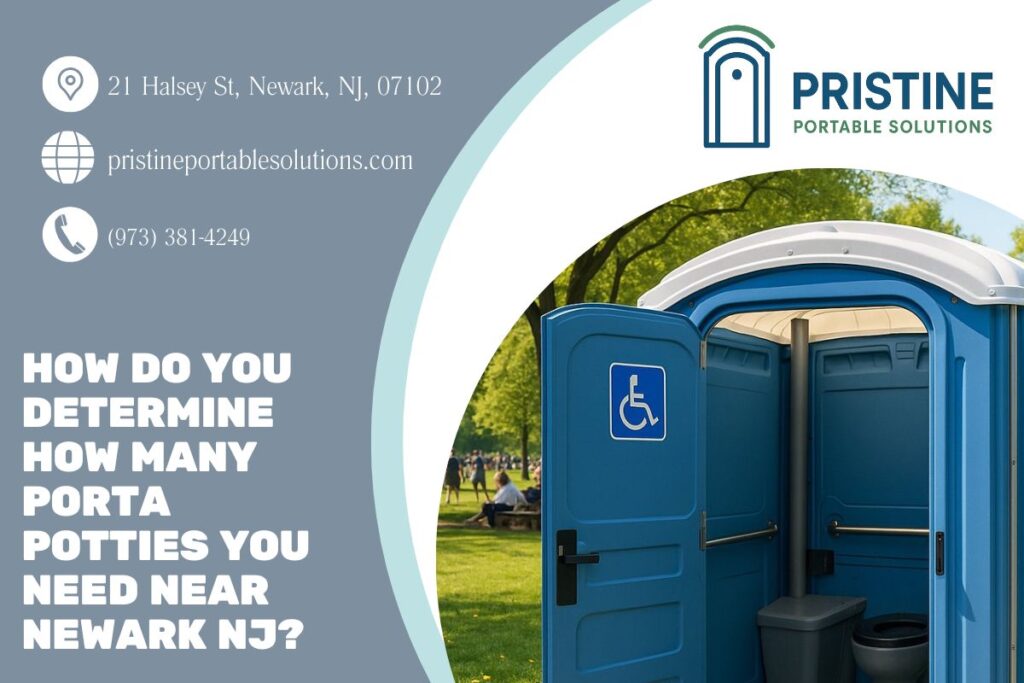
Weather conditions affect demand patterns—extreme temperatures increase restroom visits by 25%. ADA compliance requires accessible units to comprise 5-10% of your total inventory.
Event type influences requirements; concerts demand higher ratios than corporate gatherings.
You’ll enhance service delivery by integrating these data points into your procurement strategy, ensuring regulatory adherence while maintaining attendee satisfaction.
See also: porta potty rental service near Newark NJ
When calculating porta potty quantities, your headcount becomes the primary determinant of sanitation infrastructure. OSHA standards and PSAI guidelines establish baseline ratios that you’ll need to scale proportionally with your workforce or event attendance near Newark NJ.
| Attendee Count | Standard Units Required | High-Use Events* |
|---|---|---|
| 1-50 people | 1-2 units | 3 units |
| 51-200 people | 3-5 units | 6-8 units |
| 201-500 people | 6-10 units | 12-15 units |
*High-use events include concerts, festivals, or 8+ hour durations
You’ll need to account for gender-specific requirements at mixed-gender gatherings—typically maintaining a 1:3 male-to-female ratio to optimize flow. Construction sites require different calculations than special events, as workers use facilities over extended shifts rather than concentrated timeframes.
The length of your operational day directly multiplies sanitation demands—a four-hour event requires half the capacity of an eight-hour workday, even with identical headcounts.
You’ll need to calculate total person-hours, not just attendance figures, to meet OSHA’s sanitation standards and New Jersey’s regulatory requirements.
Duration-based capacity adjustments include:
You’re optimizing resource allocation when you match porta potty quantities to precise operational windows, preventing both shortages and wasteful over-provisioning throughout your Newark project timeline.
Different events and worksites generate vastly different usage patterns that override standard headcount formulas—construction crews create 40% higher per-capita demand than office park events, while festivals with alcohol service require 20-30% extra capacity beyond baseline calculations.
| Event/Worksite Type | Baseline Ratio | Adjustment Factor |
|---|---|---|
| Construction Sites | 1:10 workers | +40% peak hours |
| Corporate Events | 1:75 attendees | Standard capacity |
| Festivals (w/alcohol) | 1:50 attendees | +25% minimum |
| Multi-day Concerts | 1:100 attendees | +30% + ADA units |
You’ll need to account for activity intensity, demographic composition, and access to alternative facilities. OSHA mandates one unit per twenty construction workers, but Newark’s municipal codes may impose stricter requirements. Calculate your needs using event-specific multipliers rather than generic formulas to guarantee compliance and user satisfaction.
Before signing vendor contracts for Newark-area events, you must verify compliance with both New Jersey Department of Health sanitation standards and Essex County’s temporary facility regulations, which mandate minimum ratios of 1:250 for general admission events and 1:75 for gatherings serving alcohol.
Calculate your baseline requirements using these factors:
You’ll optimize attendee satisfaction while avoiding municipal penalties through precise capacity planning.
Private residential events require modified calculations compared to large-scale public gatherings, though you’ll still adhere to New Jersey’s base sanitation requirements.
For backyard parties with 50 guests or fewer, you’ll need a minimum of one standard unit. Add one extra unit for every 50 attendees for events exceeding this threshold.
Duration significantly impacts requirements—gatherings lasting over four hours require a 25% increase in capacity. Alcohol service accelerates usage rates by approximately 15-20%, requiring proactive adjustments.
Consider Newark’s municipal codes regarding placement distances from property lines and water sources. For multi-day celebrations like wedding weekends, implement daily servicing protocols.
Smart placement near high-traffic zones optimizes flow efficiency while preserving aesthetics. Temperature extremes during summer months warrant hand-washing stations, enhancing hygiene compliance beyond standard portable restroom configurations.
Large-scale public events demand substantially higher porta potty ratios, with New Jersey Department of Health guidelines requiring one unit per 50 attendees for the initial four hours of operation.
You’ll need to implement dynamic scaling strategies that account for Newark’s urban infrastructure constraints and peak attendance patterns.
Consider these critical optimization factors:
Strategic placement near ingress points reduces wait times and enhances throughput efficiency.
Outdoor weddings and special events in the Newark area require considerably different porta potty calculations than large public gatherings, with industry standards recommending one unit per 75-100 guests for four-hour receptions.
You’ll need to adjust ratios based on bar service intensity—open bars require more units due to higher usage frequency. For upscale events, you should allocate 60% standard units and 40% luxury restroom trailers to maintain guest satisfaction metrics.
Weather data impacts placement strategy; Newark’s summer humidity requires strategic positioning away from food service areas while maintaining ADA-compliant accessibility paths.
Multi-day events necessitate daily servicing contracts to meet health department standards. Install one handwashing station per three units, and position facilities within a 200-foot walking distance to optimize traffic flow while preserving venue aesthetics.
Because OSHA mandates specific sanitation requirements under 29 CFR 1926.51, construction sites in Newark’s jurisdiction must provide one toilet facility for every 20 workers on eight-hour shifts.
You’ll need to calculate your requirements based on these factors:
You’re required to service units at a minimum weekly frequency, though high-traffic sites require bi-weekly maintenance.
Track usage patterns through digital monitoring systems to optimize placement and prevent non-compliance penalties.
When your project timeline spans fewer than 30 days, you’ll still need to meet OSHA’s 1:20 worker-to-toilet ratio while optimizing rental costs through strategic planning.
Consider weekly rentals instead of monthly contracts to reduce expenses by 15-20%. For projects under two weeks, coordinate strategic servicing schedules—typically mid-project for 7-14 day jobs—rather than standard twice-weekly maintenance.
Newark’s permit requirements mandate sanitation facilities before work commences, so schedule delivery 24 hours pre-project. You’ll enhance efficiency by positioning units within 300 feet of workstations, per OSHA guidelines.
Thoughtful planning involves analyzing peak workforce hours: if you’re running split shifts with optimal 15 workers present simultaneously, you’ll need just one unit despite employing 30 total workers.
Calculate based on concurrent workers, not total payroll, to avoid overspending while maintaining compliance.
Long-term projects extending beyond 30 days require fundamentally different sanitation strategies that balance regulatory compliance with cost efficiency.
You’ll need to establish a comprehensive service schedule that accounts for OSHA’s requirement of one toilet per 20 workers for projects lasting more than 30 days.
Your long-term configuration should include:
You’re calculating units based on peak workforce projections, not averages.
Factor in 15-minute accessibility requirements and site expansion phases when determining ideal placement zones.
Federal regulations under 29 CFR 1926.51(c) require that you provide one toilet facility for every 20 construction workers, or fraction thereof, with facilities located within a 10-minute walk of any work location.
You’ll need to calculate based on your peak workforce count—if you have 45 workers on-site, you’re required to provide a minimum of 3 units.
OSHA also requires handwashing stations when toilets don’t include self-contained sinks. You must maintain these facilities in sanitary condition and service them regularly to prevent health violations.
For Newark construction projects, factor in multiple shifts. If you’re running two 8-hour shifts with 30 workers each, you’ll need units calculated on simultaneous occupancy, not total daily headcount.
Temperature extremes and extended project timelines require more frequent servicing beyond standard weekly maintenance.
Beyond meeting baseline OSHA requirements, you’ll need to account for actual usage patterns that greatly impact your porta potty quantities. Newark’s construction sites experience predictable surge periods that demand strategic planning.
Peak usage intervals requiring extra units:
You’ll optimize your rental quantities by analyzing your project’s specific workforce schedules.
Track wait times exceeding three minutes as your key performance indicator. Sites with staggered breaks can maintain lower unit counts, whereas synchronized schedules require 15-20% more capacity to prevent bottlenecks and maintain compliance.
How do coordinated break schedules multiply your porta potty requirements compared to staggered workforce patterns? When 100 workers break simultaneously, you’ll need 8-10 units versus 4-5 units with staggered 30-minute intervals.
OSHA guidelines require adequate facilities within a 10-minute walk, making break synchronization critical for compliance calculations.
Peak traffic amplifies by 300-400% during coordinated breaks at Newark-area construction sites. You’ll optimize placement by analyzing time-motion data: morning breaks (9:30-10:00 AM) and lunch periods (12:00-1:00 PM) show the highest demand.
Deploy mobile monitoring systems tracking real-time occupancy rates. This data reveals actual usage patterns versus theoretical calculations.
Strategic staging reduces wait times below OSHA’s recommended 10-minute threshold. Implement GPS-enabled scheduling apps coordinating maintenance visits with low-traffic windows, ensuring continuous availability during your project’s high-demand cycles.
While workplace safety regulations prohibit alcohol consumption at construction sites, special events and festivals near Newark require dramatically different calculations.
You’ll need to increase your baseline porta potty count by 15-20% when alcohol is served, as consumption directly correlates with restroom frequency.
Industry data reveals key considerations:
You’re optimizing both compliance and attendee experience when you factor alcohol service into your calculations.
Smart event planners use real-time monitoring systems to track usage patterns and proactively deploy supplementary units.
Federal law mandates that accessible restroom facilities meet specific dimensional and equipment standards for events and construction sites in Newark’s jurisdiction.
You’ll need one ADA-compliant unit per 20 standard porta potties, though OSHA recommends higher ratios for construction projects. These units require 60-inch turning radius clearance and proper ramp positioning on level ground—critical considerations for Newark’s varied terrain.
You’re looking at specialized features: grab bars positioned at 33-36 inches, interior space measuring minimum 60×60 inches, and door hardware operable with closed-fist action.
Strategic placement matters: position accessible units within 200 feet of gathering areas and along accessible routes. For events with more than 500 attendees, you’ll want to increase your ratio to 1:15 to demonstrate regulatory compliance and demonstrate progressive accessibility thinking beyond minimum requirements.
The Americans with Disabilities Act (ADA) triggers mandatory accessible restroom requirements for any public or commercial event serving 15 or more people.
OSHA extends this mandate to all construction sites with portable sanitation facilities regardless of worker count.
You’ll need ADA-compliant units when:
Strategic placement matters: position ADA units on level ground with unobstructed access paths.
Non-compliance risks fines up to $75,000 for initial violations, plus potential litigation costs.
According to ADA guidelines, you’ll need one accessible unit for every 20 standard porta potties at most events—though OSHA construction requirements differ considerably.
For construction sites, mandate one ADA unit when six or more total units are present. Public events typically require 5% of your total restroom inventory to be ADA-compliant, with a minimum of one unit regardless of event size.
Newark’s municipal code aligns with federal standards but emphasizes strategic placement: position ADA units on accessible routes with firm, stable ground and maximum 1:12 slope ratios.
Savvy planners exceed minimum ratios at senior-focused events or medical facilities, often deploying 1:10 ratios.
Calculate total attendance, event duration, and demographic composition to optimize compliance while ensuring genuine accessibility rather than checkbox adherence.
While standard porta potties require servicing every 2-3 days for events exceeding 10 hours, high-traffic Newark venues demand daily maintenance when usage exceeds 40 visits per unit daily.
Your maintenance schedule directly impacts the number of units you’ll need. Consider these frequency-based adjustments:
You’re fundamentally choosing between more units with less frequent service or fewer units requiring intensive maintenance protocols.
Newark’s regulatory standards and your event duration determine this calculation.
| Service Model | Cost Per Unit | Compliance Risk | Ideal Application |
|---|---|---|---|
| Weekly Standard | $75-95 | Low | <15 users/unit |
| Bi-Weekly Improved | $45-60 × 2 | Medium | 15-20 users/unit |
| Tri-Weekly Premium | $45-60 × 3 | Very Low | 20+ users/unit |
| Event-Adaptive | Variable | Minimal | High-traffic periods |
| Sensor-Triggered | Usage-based | Best | Tech-forward sites |
You’ll achieve 30-40% cost reduction by implementing IoT monitoring systems that trigger servicing based on actual capacity thresholds rather than fixed schedules.
Because servicing frequency directly impacts unit capacity, you can reduce your total porta potty count by 15-25% when implementing tri-weekly cleaning schedules versus standard weekly maintenance.
Strategic servicing optimization allows you to improve your infrastructure investment:
You’ll achieve cost efficiency by balancing initial rental quantities against improved maintenance intervals, particularly for extended-duration events exceeding 72 hours.
Newark and surrounding municipalities in Essex County mandate specific porta potty ratios based on your event classification, with requirements varying between 1:50 and 1:75 attendees depending on alcohol service, event duration, and venue type.
You’ll need to obtain permits from the Newark Department of Health and Community Wellness, which enforces OSHA’s one unit per 10 workers standard for construction sites exceeding 30 days.
New Jersey’s Temporary Event Sanitation Code requires accessible units comprising 5% of your total inventory, with hand-washing stations mandatory for food-service events.
You’re subject to inspection protocols verifying waste containment systems and proper placement distances from water sources.
Essex County’s environmental regulations dictate disposal procedures, while Newark’s special events office cross-references your sanitation plan against zoning ordinances before permit approval.
When planning portable sanitation for events within Newark city limits, you’ll face a multi-tiered approval process administered through the Department of Public Safety’s Special Events Unit, which cross-references your application against Title 17 (Public Events) of Newark’s municipal code.
Your permit application must specify:
You’ll need to submit applications 45 days before your event date.
The code mandates one unit per 75 attendees for events under four hours, increasing to one per 50 for longer durations.
Non-compliance triggers automatic permit denial.
Beyond municipal regulations, you’ll navigate New Jersey’s statewide sanitation framework governed by N.J.A.C. 7:26-3A (Solid Waste Management Rules) and enforced by the Department of Environmental Protection’s Bureau of Solid and Hazardous Waste Management.
These standards mandate specific waste collection frequencies, containment specifications, and disposal protocols that directly impact your porta potty deployment strategy. You’ll need units certified for septage management compliance, with waste removed at intervals preventing overflow—typically every 72 hours for high-usage scenarios.
The state requires licensed waste haulers with manifest documentation for each service, creating a traceable chain of custody. Intelligent monitoring systems help you maintain compliance automatically, transmitting fill-level data and scheduling pumping before violations occur.
This proactive approach minimizes regulatory risk while optimizing your investment in sanitation infrastructure.
Although regulatory compliance sets the baseline, accurate quantity calculations require industry-standard formulas tailored to your specific event parameters.
You’ll need to factor multiple variables into your Newark-area planning:
For multi-day events, you’ll need servicing schedules coordinated with your supplier.
Temperature extremes and hand-washing station requirements add another 10-15% to your total unit count.
You’ll face regulatory violations, unsanitary conditions, and long wait times that damage your event’s reputation. Inadequate facilities create health code violations, increase liability exposure, and frustrate attendees—potentially leading to early departures and negative reviews that affect future attendance.
You’ll find 24-48 hour delivery available from Newark NJ suppliers, though peak seasons require booking. Emergency rentals cost 15-30% more. We recommend confirming municipal permits initially, as compliance delays often exceed delivery timeframes in this jurisdiction.
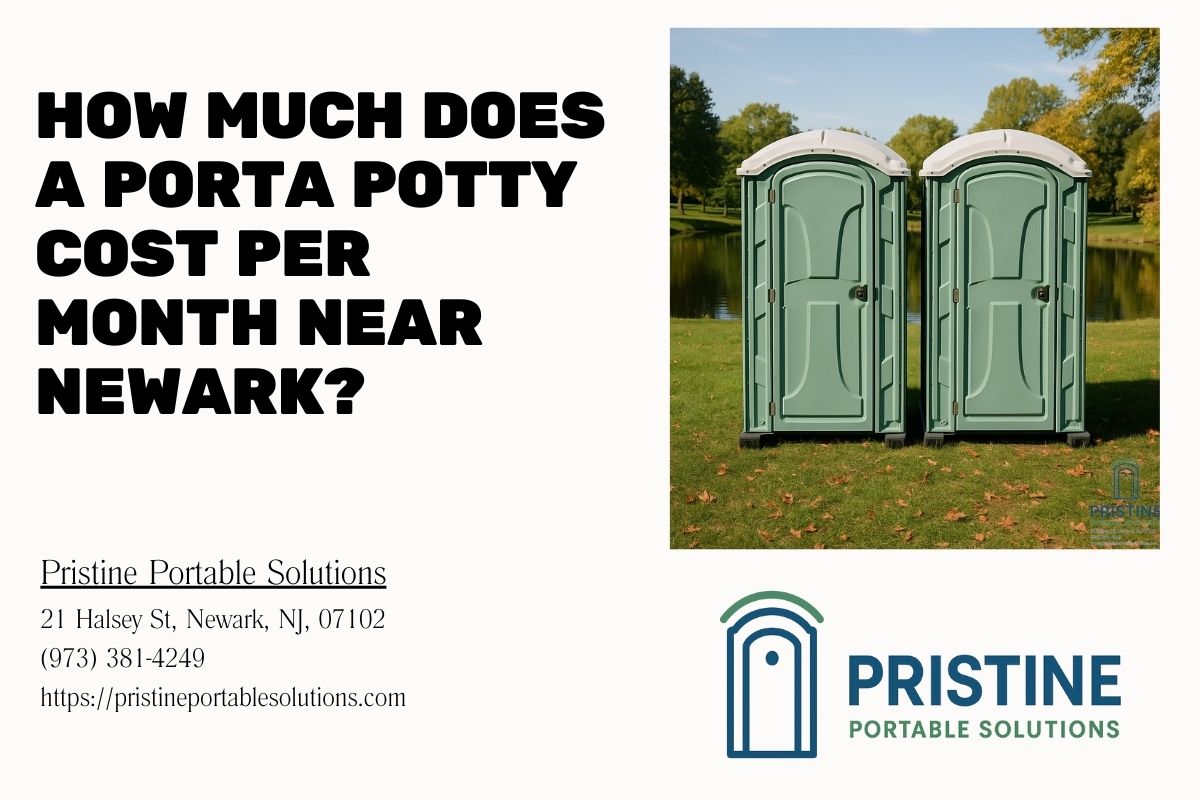
You’ll pay $75-$200 per unit monthly near Newark, depending on specifications and compliance requirements. Standard units cost less, while ADA-compliant or luxury models increase expenses. Volume discounts, delivery logistics, and servicing frequency directly impact your total rental investment.
Yes, most porta potty rental companies offer hand washing stations as add-ons or bundled units. You’ll find standalone handwash stations, combo units, or ADA-compliant models that meet New Jersey’s sanitation requirements for events and construction sites.
Your standard rental agreement includes unit delivery/pickup schedules, service frequency specifications, regulatory compliance documentation, damage liability terms, and per-unit pricing. You’ll also find cancellation policies, site access requirements, and waste-disposal protocols that comply with New Jersey’s environmental standards.





© 2026 Pristine Portable Solutions. All Rights Reserved.