
You’ll need a permit for your porta potty near Newark if you’re placing it on public property, at construction sites, or for events exceeding 200 attendees. Installations lasting more than 30 consecutive days also require permits, whereas short-term private property placements typically don’t. Newark’s Building Department handles construction-related licenses, and the Health Department must approve units near food service areas. Non-compliance can result in fines ranging from $500 to $2,000 per day, as well as immediate removal orders. Understanding specific triggers and application procedures will help you maintain full regulatory compliance.
When planning temporary sanitation facilities in Newark and surrounding municipalities, you must navigate a complex regulatory framework governing the placement of portable restrooms.
Newark’s Building Department requires permits for units on public property, construction sites, and events with attendance exceeding specified thresholds. You’ll need approval from the Health Department when placing units near food service areas or water sources.
Private property installations typically don’t require permits unless they’re connected to existing plumbing systems or remain on-site for more than 30 consecutive days.
Essex County regulations apply to parks and county-owned facilities. Each municipality surrounding Newark maintains distinct permitting protocols, so you’ll want to verify requirements with the specific jurisdiction where you’re placing your portable restroom units before installation begins.
See also: porta potty rental in Newark NJ
Because public health and environmental protection remain paramount concerns, regulatory agencies mandate permits to confirm temporary restroom installations meet established sanitation standards and prevent contamination of groundwater, surface water, and public spaces.
You’ll find permits confirm your porta potty placement doesn’t violate zoning ordinances or obstruct pedestrian pathways. They establish accountability for proper waste disposal and maintenance schedules you must follow.
Newark’s permitting process verifies that you’ve selected appropriate locations that are not within 100 feet of water sources or residential boundaries. These requirements protect your property rights while safeguarding community health.
Understanding your permit responsibilities varies by your rental arrangement and project type. Typically, you’re accountable for securing permits when you’re the property owner or primary contractor.
However, some rental agreements stipulate that the porta potty provider handles permit acquisition—you’ll need to clarify this upfront.
For construction sites, the general contractor usually bears permit responsibility. Special event organizers maintain accountability for their gatherings.
Municipal regulations in Newark clearly define the obligations of permit holders.
At Pristine Portable Solutions, we’ll guide you through Newark’s specific requirements, but ultimate permit responsibility rests with the entity legally controlling the site.
Review your contract terms carefully. We recommend confirming jurisdictional requirements early, as permit processing times affect your project timeline.
You’re free to delegate tasks, but compliance accountability remains yours.
Knowing your responsibilities is of little value if you can’t identify the conditions that trigger permit requirements.
You’ll need a permit when placing porta potties on public property, including streets, sidewalks, or municipal lots.
Construction sites typically mandate permits regardless of property type.
Events drawing more than 200 attendees often trigger permitting thresholds in Newark’s jurisdiction.
Duration matters—installations exceeding 30 consecutive days usually require authorization.
You’re also subject to permit requirements when blocking pedestrian access or vehicle traffic patterns.
Commercial developments and roadwork zones are consistently subject to regulatory oversight.
Private property doesn’t guarantee exemption if your porta potty affects drainage systems or violates setback distances from property lines.
Local zoning ordinances and health department regulations create supplementary triggers.
Understanding these specific conditions protects you from violations while maintaining operational freedom.
Construction sites in Newark are subject to mandatory permitting requirements that extend beyond standard placement protocols. You’ll need documentation that covers duration specifications, site boundaries, and waste management compliance. Long-term placements exceeding 30 days require renewal applications with updated site assessments.
| Placement Duration | Permit Action Required |
|---|---|
| Under 7 days | Standard temporary permit |
| 7-30 days | Extended placement permit |
| 30+ days | Monthly renewal documentation |
| 90+ days | Thorough site review |
Your construction project requires compliance with OSHA sanitation standards and Newark’s municipal codes. You’re responsible for maintaining placement permits throughout your project timeline. Pristine Portable Solutions handles permit coordination, ensuring you’re free from bureaucratic delays. We’ll secure necessary approvals while you focus on project execution and operational efficiency.
Public events and gatherings in Newark require advance permit applications that specify attendee counts, event duration, and precise unit placement locations.
You’ll need to submit documentation 30-45 days before your event, allowing authorities time to review your sanitation plan.
Street festivals, outdoor concerts, and community celebrations typically require special event permits, which typically include portable restroom requirements.
Newark’s health department mandates minimum ratios—one unit per 50-75 attendees for events exceeding four hours.
You’re responsible for ensuring units don’t obstruct pedestrian traffic, emergency access routes, or ADA-compliant pathways.
Your permit application must include site maps showing exact placement coordinates.
Pristine Portable Solutions handles permit coordination services, streamlining the approval process so you can focus on executing your event without regulatory complications.
When placing portable restrooms on public property or Newark streets, you must obtain a Right-of-Way permit from the Department of Engineering’s Division of Traffic and Signals. This permit guarantees your placement won’t obstruct pedestrian access or traffic flow. You’ll need to submit site plans showing exact dimensions and locations.
| Permit Requirement | Processing Time | Validity Period |
|---|---|---|
| Right-of-Way Application | 5-7 business days | Up to 90 days |
| Site Plan Submission | Required upfront | Per project |
| Insurance Certificate | Proof of $1M liability | Duration of permit |
The permit specifies placement restrictions, including minimum distances from intersections, fire hydrants, and crosswalks. You’re responsible for maintaining clear pathways and removing units when authorization expires—non-compliance results in fines and immediate removal orders.
While public property placements require formal authorization, private property installations typically don’t need permits from Newark’s municipal offices.
You’ll maintain autonomy when situating portable sanitation units in these scenarios:
You’re responsible for verifying property ownership status and confirming placement doesn’t violate local zoning ordinances or homeowner association restrictions.
For residential properties and private land installations, you’ll bypass Newark’s municipal permit requirements as long as the porta potty remains within your property boundaries. You’re free to position units for home renovations, backyard events, or construction projects without bureaucratic delays. However, you must comply with setback requirements from property lines and ensure proper waste disposal protocols.
| Property Type | Permit Status | Key Requirement |
|---|---|---|
| Single-family residential | Not required | Stay within boundaries |
| Multi-unit private property | Not required | Follow HOA guidelines |
| Commercial private land | Verify zoning | Check local ordinances |
You’ll want to confirm that your property isn’t in a special zoning district or a historic preservation area, which may impose additional restrictions. Pristine Portable Solutions helps you navigate these distinctions efficiently.
Short-term installations lasting 30 days or fewer typically receive expedited permit processing through Newark’s Office of Engineering.
You’ll find that temporary scenarios often qualify for streamlined approval, allowing you to move forward quickly with your project.
Common short-term scenarios requiring permits:
Your temporary permit application typically receives approval within 24-48 hours when documentation’s complete.
Understanding Newark’s municipal code alongside New Jersey state statutes guarantees your porta potty installation maintains full compliance with both regulatory frameworks.
Newark requires construction sites that exceed specified worker thresholds to provide sanitation facilities in accordance with local ordinances. You’ll need to verify placement doesn’t violate setback requirements from property lines or obstruct public rights-of-way.
New Jersey’s Department of Environmental Protection mandates proper waste handling procedures, while the state’s Public Employees Occupational Safety and Health Act establishes minimum sanitation standards for job sites.
Your rental location may trigger supplementary zoning clearances if you’re placing units on residential properties or near protected waterways.
Newark’s Department of Engineering handles right-of-way permits when units occupy sidewalks or streets. You’re responsible for obtaining documentation before installation to avoid penalties and operational delays.
Newark’s municipal code establishes specific requirements for temporary sanitation facilities through Chapter 17 (Zoning) and Chapter 28 (Public Property, Streets and Sidewalks).
You’ll need to understand these regulations to operate within legal parameters.
Key municipal requirements include:
Newark’s Division of Engineering reviews placement applications to guarantee compliance.
You’re responsible for obtaining proper authorization before installation.
Contact the Municipal Building at 920 Broad Street for permit applications and clarification on zone-specific regulations.
Beyond municipal regulations, New Jersey’s Department of Health enforces statewide sanitation standards governing all portable restroom operations under N.J.A.C. 8:24 (Sanitation in Temporary Labor Camps and Food Establishments). You’ll need to understand these requirements before placing units on your property.
| Requirement | Specification |
|---|---|
| Servicing Frequency | Minimum weekly for standard events; daily for high-volume locations |
| Waste Disposal | Only through licensed septage haulers registered with NJDEP |
| Hand Sanitizer | Required at each unit; must contain minimum 60% alcohol content |
You’re responsible for ensuring your rental provider complies with state regulations. Non-compliance can result in fines up to $2,500 per violation. Pristine Portable Solutions maintains all required certifications and adheres to N.J.A.C. protocols, giving you peace of mind while meeting your sanitation needs independently.
Where do you begin when traversing Newark’s permitting process for portable restrooms? You’ll navigate the application efficiently by following these steps:
Keep your permit documentation on-site during the rental period.
You’re responsible for ensuring all placements comply with setback requirements and accessibility standards.
Gathering your paperwork before applying streamlines the permit process and reduces the risk of application rejection.
You’ll need your site plan showing exact porta potty placement locations with measurements from property lines. Include your event details: date, duration, expected attendance, and address.
Property owner authorization is mandatory if you’re not the owner. Your contractor’s business license and insurance certificate must be current—Pristine Portable Solutions provides these documents to clients automatically.
Submit your waste disposal plan outlining servicing frequency and approved hauling methods. Newark requires a completed application form with applicable fees.
You’ll also need proof of ADA compliance for any public event you host. Keep copies of all submissions for your records and ensure you maintain documentation in case inspectors request verification during your event.
Maneuvering Newark’s permit submission process requires directing your application to the correct municipal department based on your porta potty placement location.
Submit your permit applications through these designated channels:
Once you’ve submitted your application to the appropriate Newark department, understanding processing times helps you plan your porta potty installation schedule accordingly. Newark typically processes standard permits within defined timeframes, depending on project complexity and location.
| Permit Type | Standard Processing | Expedited Option |
|---|---|---|
| Construction Sites | 5-7 business days | 2-3 business days |
| Special Events | 10-14 business days | 3-5 business days |
| Long-term Placement | 7-10 business days | 3-4 business days |
You’ll receive approval notifications via email or postal mail. Submit applications well before your installation date to avoid delays. Incomplete applications reset processing timelines, so verify you’ve included all required documentation. Pristine Portable Solutions can guide you through Newark’s permitting process and ensure compliance with local regulations.
Understanding Newark’s permit fee structure guarantees you budget appropriately for your porta potty installation beyond the rental costs themselves.
Newark’s Department of Engineering establishes permit fees based on your project’s scope and duration:
You’ll receive detailed cost breakdowns during your application submission, enabling transparent financial planning and avoiding unexpected regulatory expenses.
Application fees represent the initial financial requirement you’ll submit alongside your porta potty permit request to Newark’s Department of Engineering.
Standard permit fees typically range from $50 to $150, depending on your placement duration and location specifications. You’ll pay higher rates for extended timelines or for high-traffic areas that require additional municipal oversight.
Newark processes payments through multiple channels—online portals, certified checks, or money orders—giving you flexibility in your transaction method.
The fee structure reflects administrative processing costs, site inspection requirements, and regulatory compliance documentation. You won’t receive refunds if your application faces denial, so you’ll want to ascertain your submission meets all municipal codes before payment.
Payment confirmation serves as your official receipt and is required for permit tracking.
Beyond your initial permit fees, inspection and compliance costs constitute mandatory expenses you’ll incur throughout your porta potty installation’s lifecycle.
Newark’s regulatory framework requires adherence to specific standards that protect your autonomy while ensuring public health compliance.
You’ll encounter these inspection and compliance expenses:
Pristine Portable Solutions handles all compliance documentation, letting you focus on your project rather than bureaucratic requirements.
We’ll navigate these obligations efficiently, minimizing your administrative burden.
When positioning your porta potty in Newark, you’ll need to satisfy specific placement regulations that govern setback distances, accessibility standards, and site-specific restrictions. Newark’s municipal code mandates minimum clearances from property lines, water sources, and public walkways. You’re required to maintain ADA-compliant pathways and guarantee adequate vehicular access for servicing.
| Requirement | Minimum Standard | Authority |
|---|---|---|
| Property Line Setback | 10 feet | Newark Zoning |
| Water Source Distance | 100 feet | NJ DEP |
| ADA Path Width | 36 inches | Federal ADA |
You must also verify underground utility locations before installation and maintain proper drainage away from adjacent properties—non-compliance results in citation notices and mandatory repositioning at your expense. Pristine Portable Solutions handles these compliance requirements throughout your rental period.
Newark’s zoning ordinances establish specific zones where portable sanitation units may be legally placed, with particular emphasis on commercial, industrial, and designated construction areas.
You’ll need to maintain precise distances from protected locations to operate without violations.
Distance Requirements You Must Follow:
You’re free to position units anywhere within these parameters.
Document your measurements carefully, as inspectors verify compliance through site surveys before issuing operational permits.
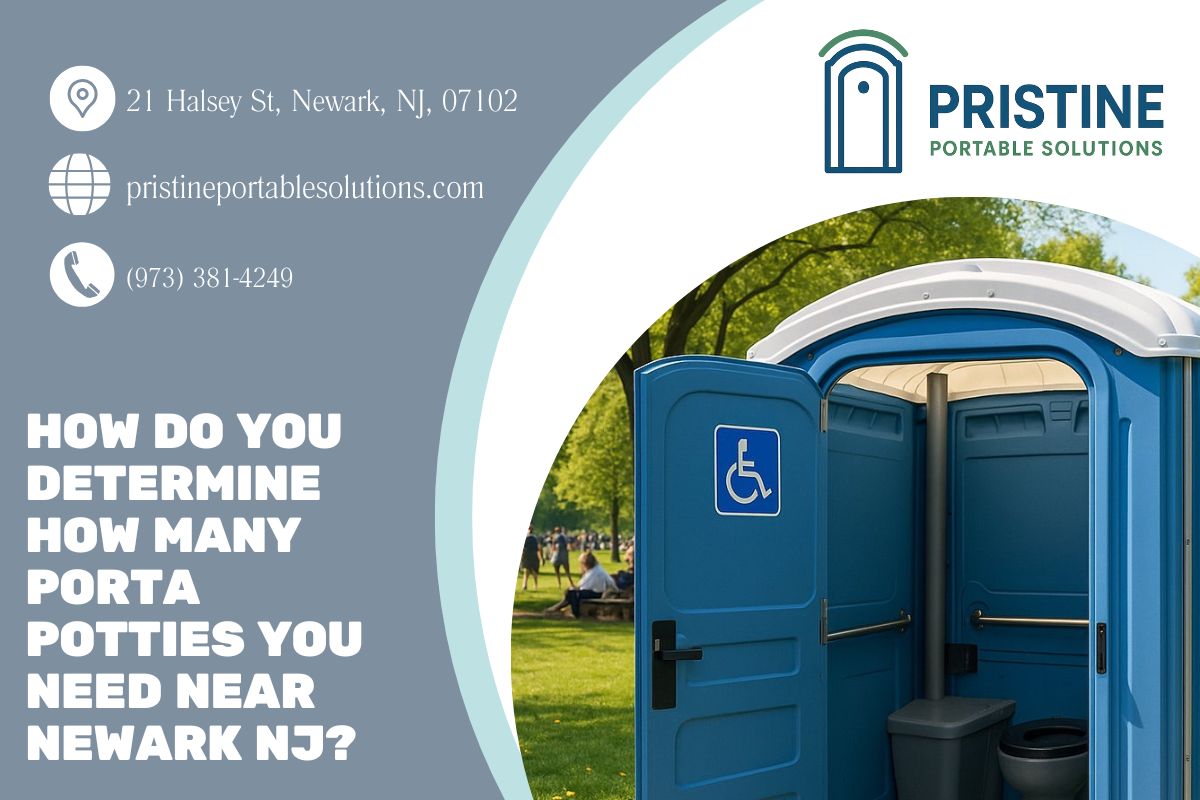
Federal law requires you to provide accessible, portable restroom facilities when your site includes five or more standard units, with at least one ADA-compliant unit per cluster. You’ll need proper documentation showing compliance with accessibility standards when obtaining permits.
| Requirement | Standard Unit | ADA-Compliant Unit |
|---|---|---|
| Interior Space | 43″ × 46″ | 60″ × 60″ minimum |
| Door Width | 24″ | 32″ minimum |
| Grab Bars | Not required | Required both sides |
| Height Clearance | Standard | 56″ minimum |
Your ADA units must be positioned on firm, level ground with accessible routes from parking areas and event spaces. You’re responsible for maintaining these accessibility features throughout your rental period, ensuring grab bars remain secure and entryways stay unobstructed. Non-compliance results in permit violations and potential fines.
Operating portable restrooms without proper permits exposes you to escalating enforcement actions, beginning with immediate cease-and-desist orders from Newark’s Department of Health and Community Wellness.
You’ll face these specific consequences:
Your certificate of occupancy or event permit becomes void when sanitation requirements aren’t met.
Insurance policies often exclude coverage for unpermitted facilities, leaving you personally responsible for damages.
Newark’s enforcement team conducts routine inspections, making detection inevitable rather than theoretical.
Understanding the enforcement actions you’ll encounter is only part of the equation—you must also know the exact financial and legal penalties Newark imposes for permit violations.
Operating without proper authorization typically results in fines ranging from $500 to $2,000 per day, depending on the severity of the violation. You’ll face immediate cease-and-desist orders requiring rental removal within 24-48 hours.
Repeat offenses increase penalties significantly, potentially reaching $5,000 per day. Municipal authorities may pursue legal action against your project, resulting in construction delays and contract breaches.
Citation records remain on file, complicating future permit applications. Non-compliance also exposes you to liability claims if sanitation issues arise.
These financial consequences far exceed standard permit fees, making compliance your most cost-effective path forward.
You’ll typically need to update your permits before relocating a porta potty. Moving without proper authorization violates municipal regulations and exposes you to fines. Contact Newark’s permitting office initially—they’ll expedite updates so you can relocate compliantly and avoid penalties.
Most rental companies, including Pristine Portable Solutions, can handle permit applications on your behalf, though you’ll retain ultimate responsibility for compliance. You’re free to self-apply if you’d prefer direct control over the permitting process and timeline.
You’ll need to contact Newark’s permitting office immediately to request cancellation or transfer. Most permits aren’t refundable, but you may transfer it to a rescheduled date. Documentation of cancellation is required to avoid compliance issues or penalties.
You’ll typically need permits for porta potties at Newark wedding venues, especially on public property or parks. Private venues may have different requirements. Contact Newark’s Building Department directly to verify specific compliance obligations and secure your freedom to celebrate.
You should submit your porta potty permit application at least 30 days before your event. This timeframe guarantees you’ll receive approval without delays, giving you the freedom to finalize arrangements and avoid last-minute compliance issues or potential penalties.

© 2026 Pristine Portable Solutions. All Rights Reserved.